
Analysis / 3D web and commerce
Web apps for smart glasses: should Spanish brands act now?
Smart glasses are beginning to incorporate displays, opening up new ways to access information without taking out a phone. Ray-Ban Display has reached several European markets, but Spain is not on the announced list.
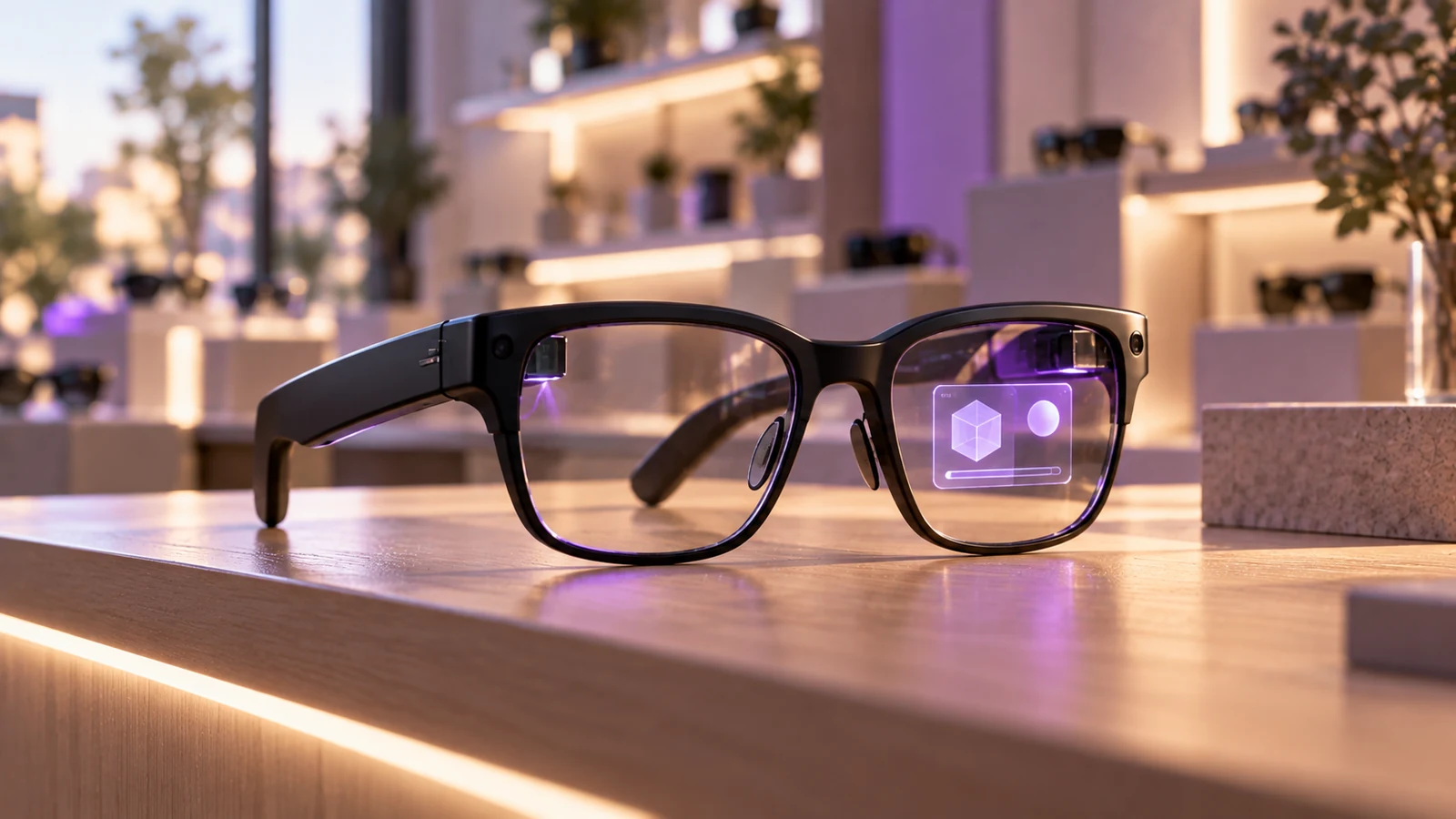
A Spanish brand does not need to launch an app for smart glasses immediately, but it can start assessing whether this channel fits its products and customers. At Connect 2026, Meta announced the international expansion of Ray-Ban Display and the ability to develop visual web apps for the glasses. This is a development worth following, although it does not, by itself, justify a major commercial investment in Spain.
The important distinction is that product availability and the ability to build experiences for a device are not the same thing. As of 14 October 2026, the glasses are on sale in France, Italy and Germany, with availability beginning on 13 October and an announced starting price of €899. Spain is not on the list, and the available information does not confirm a Spanish launch date.
What has Meta announced, and why does it matter?
At Connect 2026, held on 23 September, Meta announced the international rollout of Ray-Ban Display. Reservations opened in France, Italy and Germany, and retail availability began on 13 October. Road to VR and UploadVR report the dates and announced price.
UploadVR also reports that developers can already create visual web apps for the glasses. The Explore app, meanwhile, was announced for later in the year. This creates an opportunity for teams working on web experiences to investigate the platform, without assuming that a native SDK is available or that every feature is accessible in every market.
Keep three separate questions in view: where the glasses are sold, what developers can build and which experiences would be useful to a brand. The first depends on retail availability; the second on the announced development capabilities and conditions; the third requires a real use case to be tested.
What changes when the experience uses web apps?
A route based on visual web apps could lower the initial barrier for teams that already build web products. Rather than assuming they need to create a complete native application, they can investigate whether a small visual experience solves a specific problem.
That does not mean an existing website will automatically work on the glasses. Do not assume compatibility, available controls, supported formats or technical capabilities that have not been confirmed. Before designing a solution, check the development tools and conditions available for the device.
For an e-commerce business, one hypothesis might be to display concise product information or help someone identify an item while keeping their hands free. An industrial business could investigate whether contextual information or instructions would be useful. These are ideas to test, not features that should be assumed to be available on the glasses.
| Criterion | What to check |
|---|---|
| Availability | The device can be purchased and used in the target market. |
| Development access | Suitable tools and conditions exist for the intended use case. |
| Customer need | The information is useful when accessed without a phone. |
| Interaction format | Content can be understood on a display in a different usage context. |
| Feasibility | The test can be carried out without building an entire platform. |
| Measurement | You define what result would justify continuing. |
What should a Spanish brand do now?
The recommendation is to explore, not invest at scale. Start by identifying a specific task that could be improved by displaying information on glasses. Avoid treating the project as a general adaptation of your entire website: an experience designed for a conventional screen will not necessarily work well for a brief interaction on a wearable device.
Next, review official updates and the conditions for accessing development tools. Since Spain is not included among the announced markets in the available information, do not base a project schedule on a Spanish launch date that has not been confirmed.
A useful test should be small and answer a commercial question. Define the user, the context, the information they need and the expected outcome. If you cannot explain why that information is more useful on glasses than on a phone, you probably do not yet have a strong enough reason to develop it.
This approach fits into the wider evolution of extended reality. Our analysis of XR in 2026 and the role of virtual reality provides useful context without treating every device as offering the same opportunities.
How to avoid investing too early
Do not commission a complete experience simply because a manufacturer has opened a new platform. First, establish whether your audience can access the device, whether the tools can deliver the experience and whether there is a genuine need to maintain it. Then compare the cost and usefulness with a conventional mobile or web solution.
It is also worth watching developments in browsers and web capabilities, as these can affect how interactive experiences are distributed. Our article on the web in 2026 without polyfills places this decision within a broader web strategy.
This week, document one use case, list what you need to verify and set a clear condition for proceeding or stopping. You do not need to start development yet. You need enough evidence to decide whether the channel is right for your brand.
At Contrast 3D, we work on web development and XR, AR and 3D experiences. Tell us which product or process you want to explore and we can help you assess a focused test before committing budget to a platform that has not yet been announced for Spain.
Sources
Checked on October 14, 2026