
Analysis / Development and agents
GameMaker goes free for commercial games from 2027
A small studio or brand commissioning a promotional game needs to choose its engine before committing to production. GameMaker's new commercial terms could remove a licensing cost, but the runtime, target platforms and release date determine whether the change applies.
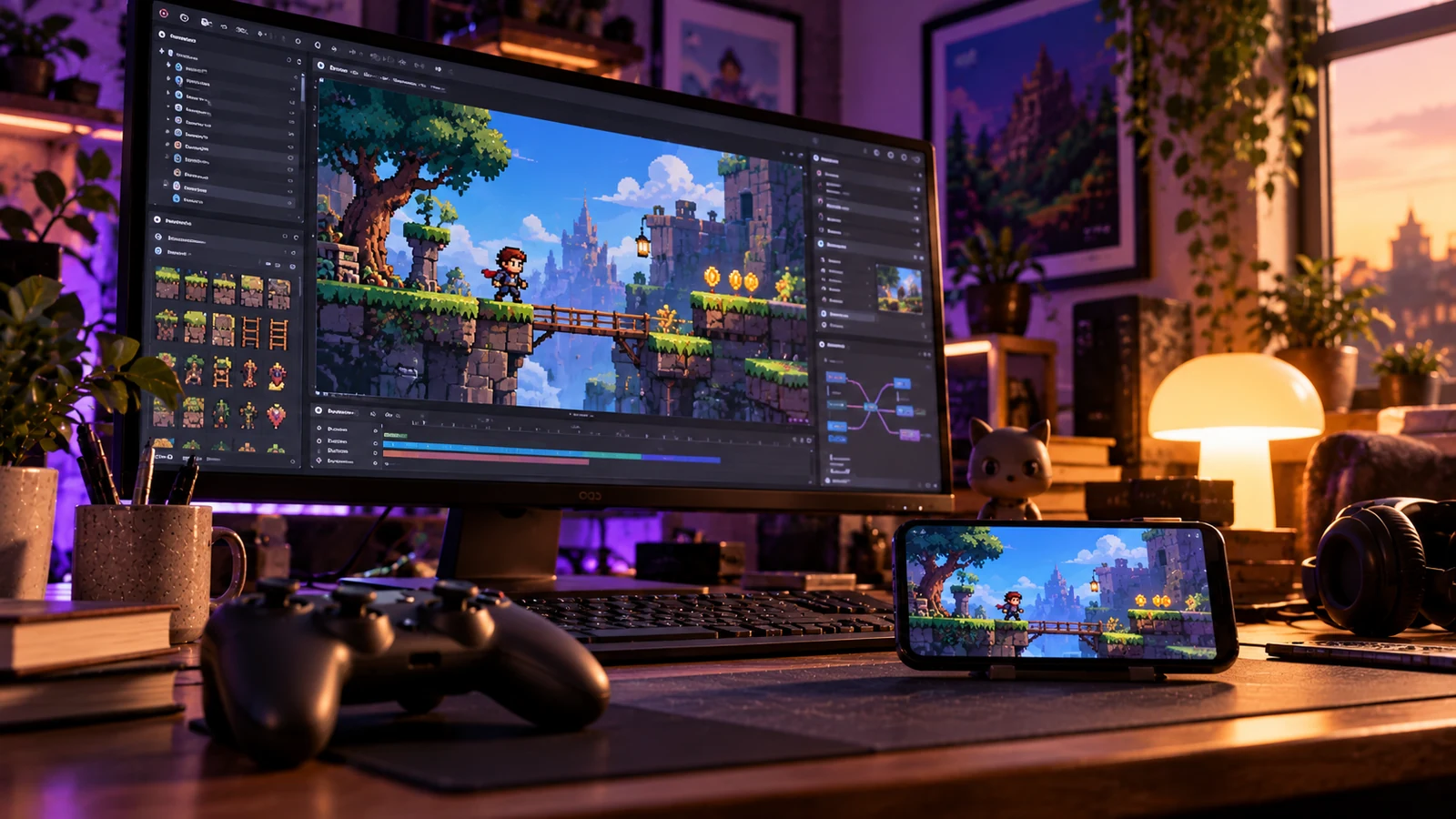
GameMaker will allow commercial games built with its new GMRT runtime to be released without a Professional licence from 1 January 2027. The policy covers desktop, mobile, web and GX Games. It does not extend to commercial projects using the older GMS2 runtime, and console publishing will continue to require separate authorisation and licensing.
GameMaker announced the change on 23 October 2026 in its official GMRT update. GameFromScratch subsequently confirmed the start date, eligible platforms and important exceptions.
For small game studios and businesses commissioning branded games, removing a commercial engine licence may simplify budgeting. Whether it makes GameMaker the right choice is a separate decision.
What becomes free on 1 January 2027?
The announcement applies specifically to GMRT, GameMaker's next-generation runtime.
A runtime is the technology responsible for executing a game. The distinction matters because the editor and the runtime do not necessarily carry identical commercial licensing conditions.
Under the new policy, developers using GMRT will be able to create and commercially distribute games without purchasing a Professional licence for:
- Desktop: games released for computers.
- Mobile: games targeting mobile devices.
- Web: browser-based games.
- GX Games: games published through GameMaker's gaming platform.
The effective date is 1 January 2027. The policy is not already in force simply because it has been announced.
GameMaker will also provide access to the GMRT source code across all licensing tiers.
This gives developers an opportunity to inspect the runtime and potentially adapt it to specific technical requirements.
The official announcement also confirms that existing licence tier prices are not changing.
Existing GMS2 projects are treated differently
The licensing change does not apply to every GameMaker project.
Commercial games using the existing GMS2 runtime will still require the relevant paid licence.
This matters for teams maintaining established projects or relying on features of the older runtime.
Moving a project to GMRT should not be assumed to be effortless. Any transition needs testing to establish whether existing mechanics and platform-specific behaviour continue to work correctly.
As GameFromScratch explains, the commercial licensing exemption is tied to GMRT rather than GameMaker development in general.
The release date also matters.
A game that must be commercially distributed before 1 January 2027 cannot rely on the announced future exemption.
For teams already committed to a production schedule, that distinction should be reflected in the budget.
Console development still requires an Enterprise licence
Console publishing remains an exception regardless of which runtime a project uses.
Developers must meet two requirements:
1. Hold an Enterprise licence.
2. Have approved developer status for the relevant console platform.
These requirements apply to both GMRT and GMS2.
A browser-based promotional game and a console release therefore have different licensing implications, even if the gameplay is similar.
The GameMaker announcement explicitly preserves the existing console conditions.
Businesses considering a later console release should account for those requirements during planning rather than assuming the free commercial policy covers every distribution channel.
Will this make branded games cheaper to produce?
It can remove a licensing expense, but it does not remove the work involved in creating the game.
Consider a brand commissioning a browser-based mini-game for a marketing campaign.
If the game uses GMRT and is commercially distributed once the new terms apply, a Professional licence will not be required for that use.
The production team must still design the mechanics, develop the game, create visual assets and test the finished experience.
Character artwork, environments, animation, interface design and sound all require production time.
Testing also varies by platform. Browser games need to be checked against their intended environments, while mobile games require suitable controls and device testing.
Publishing and ongoing maintenance introduce further responsibilities.
A free engine licence should therefore be treated as one reduced cost, not as a free game development service.
Our article on in-house art production costs versus outsourcing explains how to assess the creative production work separately from technology licensing.
What should you check before choosing GameMaker?
| Criterion | What to check |
|---|---|
| Runtime | Confirm that the project uses GMRT rather than the older GMS2 runtime. |
| Release date | Check whether commercial distribution is planned from 1 January 2027 onwards. |
| Target platforms | Confirm that desktop, mobile, web or GX Games cover the intended release. |
| Console publishing | Account for the Enterprise licence and approved developer status. |
| Beta status | Test the GMRT features required by the project before committing to production. |
| Existing projects | Validate any runtime transition rather than assuming compatibility. |
| Source code access | Decide whether the team needs to inspect or adapt GMRT internals. |
| Production budget | Include game design, art, development, testing and publishing. |
These checks are particularly valuable when the game is being commissioned by a business rather than developed as an internal experiment.
They help establish whether the planned technology fits the deliverables before significant production work begins.
GMRT is still in beta: why that matters
GameMaker has confirmed that GMRT remains in beta, with its rollout continuing across platforms.
The commercial licensing announcement does not mean the runtime is feature-complete or suitable for every production requirement.
For a new game, a practical first step is to build a prototype containing the essential gameplay systems.
That prototype should be tested on the intended release platform before a larger art and content budget is committed.
Any unusual technical requirements should be checked at the same stage.
Other engines may also be worth considering. Godot, for instance, is open-source software distributed under the MIT licence.
The appropriate choice depends on the game being built rather than the headline licensing terms alone.
For games involving 3D assets, performance requirements also influence production. Our guide to why there is no universal polygon budget explains why geometry targets depend on the intended devices and use cases.
What should you decide this week?
If you are planning a desktop, mobile or browser game for 2027, add GMRT to your engine evaluation and test the mechanics your project requires. Keep existing licensing requirements in your budget if you depend on GMS2, need to release before 2027 or intend to publish on consoles. If your business is considering a branded game, tell us what experience you want to create so we can define the production requirements before selecting the engine.
Sources
Checked on October 25, 2026